
Can I Travel to Turkey? Complete 2026 Visa and Entry Guide
If you’re asking “can I travel to Turkey?” — the short answer for most travelers is yes, and it’s likely easier than you think. Turkey has steadily expanded its visa-free list over the past few years, and entry rules now vary significantly depending on your nationality. This guide breaks down exactly who can travel freely, who needs an e-visa, who needs a full visa, and everything else you need to check before booking your flight.
Can I Travel to Turkey Without a Visa?
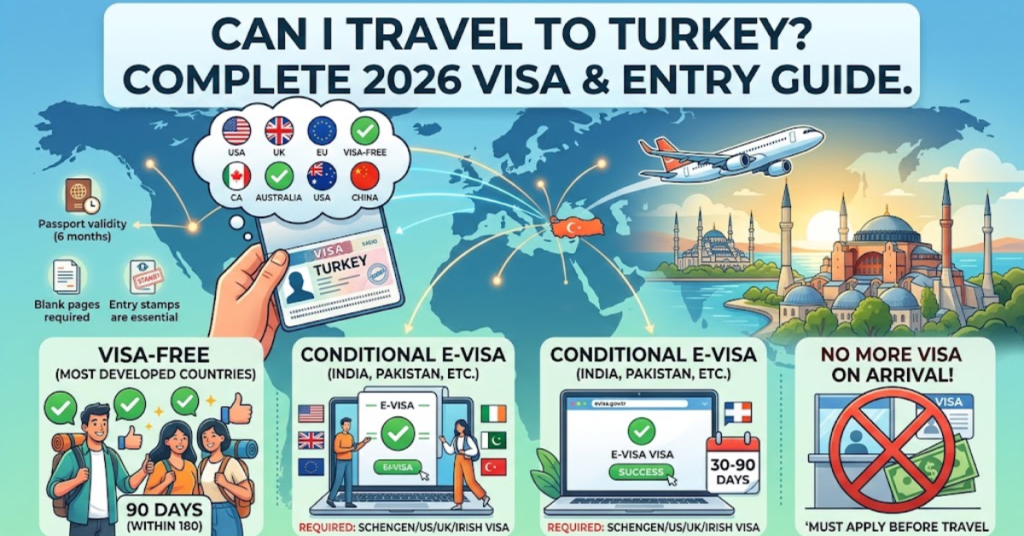
Yes, if you hold a passport from one of roughly 88 countries currently on Turkey’s visa-exempt list. As of 2026, this list includes:
- United States — visa-free since December 2023, when Turkey dropped its e-visa requirement for American citizens
- United Kingdom — visa-free
- All European Union countries, plus Switzerland, Norway, and Iceland
- Gulf states — UAE, Saudi Arabia, Bahrain, Oman, Qatar, and Kuwait
- Australia — most recently exempted, effective April 17, 2026
- China — added to the visa-free list in January 2026
- Dozens of other countries across Europe, South America, and the Middle East
If your country is on this list, you can simply show up with a valid passport and stay for tourism or short business purposes for up to 90 days within any 180-day period — no application, no fee, no advance paperwork required.
An Important Change: No More Visa on Arrival
One thing many older travel guides still get wrong: Turkey removed its visa-on-arrival system. You cannot simply land and buy a visa at the airport anymore. If your country isn’t on the visa-free list, you must apply for your visa or e-visa online before you travel — showing up without one can mean being denied boarding or turned away at the border.
Can I Travel to Turkey With an E-Visa?
If your country isn’t on the visa-free list, the next question is whether you qualify for Turkey’s e-visa system — and here’s where it gets more specific than most people expect.
For a number of nationalities, including India, Pakistan, Bangladesh, Sri Lanka, Nepal, and Iraq, the e-visa isn’t automatically available to everyone. Instead, it follows a conditional rule: you can only apply for the quick online e-visa if you already hold a valid Schengen, US, UK, or Irish visa or residence permit — and that supporting visa or permit must still be valid both when you apply and when you actually enter Turkey.
What This Means in Practice
- Indian citizens: Can get the e-visa online at evisa.gov.tr only if they hold a valid Schengen, US, UK, or Irish visa or residence permit. There is no visa on arrival.
- Pakistani citizens: Same conditional rule applies. With a qualifying visa, the e-visa typically grants a 30-day single-entry stay. Without a supporting visa from one of those regions, you’ll need to apply directly through a Turkish embassy or consulate.
- South African citizens: A different system applies here — South Africans can apply for either a one-month single-entry e-visa online, or a three-month multiple-entry sticker visa through a Turkish consulate, without needing a third-country visa first.
If you don’t hold a qualifying supporting visa and your nationality requires one, your only route is applying through a Turkish embassy or consulate before travel.
Can I Travel to Turkey for Work or Study?
This is where the rules change entirely, regardless of your nationality. Visa-free entry and e-visas are intended strictly for tourism and short business visits — not for employment, academic study, scientific research, or joining family long-term.
If any of the following apply to you, you must obtain a sticker visa from a Turkish embassy or consulate before you travel:
- You plan to work in Turkey
- You’re enrolling in a study program
- You’re conducting academic or scientific research
- You’re joining family members for long-term residence
This cannot be arranged after you’ve already entered the country — it must be sorted out in advance.
Entry Requirements That Apply to Everyone
Regardless of whether you’re visa-free, using an e-visa, or holding a full visa, these baseline requirements apply to all travelers entering Turkey:
- Passport validity: Your passport must be valid for at least 6 months beyond your date of entry into Turkey.
- Blank pages: You need at least one blank page available in your passport for entry and exit stamps. Not having enough space can result in denied entry.
- Proof of onward travel: Border officers may ask to see a return or onward ticket.
- Accommodation details: Be prepared to show your hotel booking or travel itinerary if asked.
- Entry and exit stamps: Make sure you actually receive your entry stamp — police and immigration officials may check this later to confirm you’re in the country lawfully, and some domestic airlines require a valid entry stamp to let you fly within Turkey.
What Happens If I Overstay in Turkey?
If you stay beyond your permitted 90 days (or whatever period your visa grants), the consequences are real and can follow you beyond that single trip:
- Fines proportional to how long you overstayed
- A ban on future entry into Turkey
- Complications with future visa applications, since Turkish authorities review your travel history
If you think you might need more time than your visa-free or visa period allows, it’s worth exploring your options — such as applying for an extension or residence permit — well before your permitted stay runs out, rather than risking an overstay.
Also Read About: mediterranean aegean tourism growth
Special Cases to Be Aware Of
A few additional situations are worth knowing about before you travel:
- Diplomatic and official passports require a visa regardless of nationality — the visa-free list applies only to ordinary tourist passports.
- Prior law enforcement or immigration issues in Turkey: If you’ve previously had any law enforcement or immigration violation while in Turkey, you must obtain a visa from a Turkish embassy or consulate before returning, even if your nationality is normally visa-exempt.
- ETIAS is not relevant to Turkey: Some travelers confuse Turkey’s entry system with Europe’s upcoming ETIAS travel authorization. Turkey operates its own separate visa and immigration system entirely, and that won’t change even once ETIAS eventually launches for the Schengen Area.
Quick Reference: Can I Travel to Turkey Based on My Nationality?
| Nationality | Visa Required? | Stay Allowed |
|---|---|---|
| United States | No | 90 days within 180 days |
| United Kingdom | No | 90 days within 180 days |
| EU countries | No | 90 days within 180 days |
| Australia | No (since April 2026) | 90 days within 180 days |
| China | No (since January 2026) | 90 days within 180 days |
| India | Conditional e-visa (needs Schengen/US/UK/Irish visa) | Typically 30 days |
| Pakistan | Conditional e-visa (needs Schengen/US/UK/Irish visa) | Typically 30 days (single-entry) |
| South Africa | E-visa or sticker visa | 1–3 months depending on type |
Bottom Line
So, can you travel to Turkey? For the vast majority of travelers from the US, UK, EU, and a growing list of other countries, the answer is a simple yes — no visa needed, no paperwork, just a valid passport and up to 90 days to explore. For travelers from countries like India, Pakistan, or South Africa, the path usually involves either holding a qualifying third-country visa for the e-visa route, or applying directly through a Turkish embassy. Whichever category you fall into, double-check your passport’s validity and blank pages, keep proof of your travel plans handy, and make sure you understand your permitted stay length before you fly — Turkey’s entry rules have changed significantly in the past two years, and they can change again.
Also Read More Informational Articles At: worldtrendsblog.com



Pingback: Best Time to Visit Nova Scotia: Season-by-Season Guide - World trends